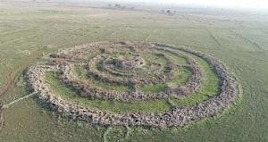

The newly discovered sites all share a similar design: large circular structures, between approximately 50 to 250 meters in diameter, built with stones taken from local basalt fields.
The stone circles of Rujm el-Hiri, nicknamed “Israel’s Stonehenge” or “Gilgal Refaim,” are not the only ones of its kind, according to a new study by Ben-Gurion University of the Negev (BGU) researchers.
By using advanced satellite imagery and remote sensing technology to survey areas previously inaccessible, BGU researchers have identified at least 28 other sites within 25 kilometers of Rujm el-Hiri that were not previously known.
The findings, recently published journal PLOS One, suggest that Rujm el-Hiri was not a singular, isolated monument, but rather an “elaborate example of a widespread architectural tradition integrated into the social and economic systems of the proto-historic Levant.”
Rujm el-Hiri was first discovered in the Golan Heights in 1968, and has been dated to approximately 3,500 and 6,500 years ago. It is made of a central cairn encircled by multiple concentric basalt stone rings, spanning for over 150 meters in diameter.
Satellite imagery revealed that the newly discovered sites share a similar design: large circular structures, between approximately 50 to 250 meters in diameter, built with stones taken from local basalt fieldstones.

Site part of a broader social, economic system
The discovered structures contain circular walls and internal partitions, often located near seasonal water sources and integrated into agricultural land use, revealing how ancient populations managed their resources and moved across the area.
Further, researchers believe the stone circles may have been multi-purpose, serving as ritual gathering places, territorial markers, or assembly sites for ancient herding communities, adding to earlier theories of Rujm el-Hiri being a burial site or astronomical observatory.
According to Dr. Michal Birkenfeld of BGU’s Department of Archaeology, the circles “invite a reinterpretation of significant proto-historic monuments in the region, recognizing them as integral parts of broader social and economic systems.”
"Our analysis may have implications for previous interpretations of Rujm el-Hiri's function," she concluded. "While traditional archaeological methods remain essential, this landscape-based perspective allows us to reach a fuller understanding of these monuments within our shared human past."
LATEST POSTS
- 1
 Potential Houthi threat to Red Sea shipping could further damage global economy
 - 2People can't get enough of this couple's Hallmark movie reviews. They don't know the painful backstory.
- 3Many European nations want Israel to cancel 19 new settlement plans
- 4Inconceivable Spots To Stargaze All over The Planet
- 55 Family SUVs for 2024: Which One Accommodates Your Family's Needs\uff1f



- Figure out How to Remain Informed about the Most recent Open Record Extra Offers
- Top Music and Dance Celebration: Which One Gets You Going?
- Chevron Says Damage at Wheatstone LNG Will Hamper Restart
- The Meaning of Breaking the Pen's Nib in Death penalties
- Excited visitors for NASA's moon launch jockey for prime views
- The Best Business visionaries Under 30
- 'Hero' who wrestled gun from Bondi shooter named as Ahmed al Ahmed
- Manual for Mountain Objections on the planet
- Two UN peacekeepers killed in explosion in Lebanon