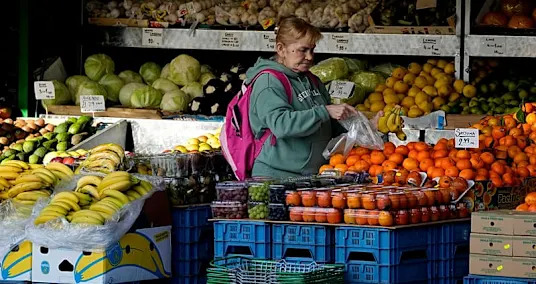
The joint US–Israeli strikes on Iran and Tehran’s response have pushed oil prices higher, with Brent crude frequently rising above $100. Experts say this will affect not only energy prices but also food prices.
The impact could be particularly strong in Europe, leading to higher food costs and a rising cost of living.
So, how will the crisis in the Middle East affect food prices across Europe? Which countries are more vulnerable and why?
Experts talking to Euronews Business point out that the crisis is expected to push global food prices higher through multiple channels.
"Global, as well as European, food prices are expected to rise because of the conflict due to the disruption of fertiliser and energy supply, as well as rising shipping costs,” Zsolt Darvas, senior fellow at Bruegel, told Euronews Business.
He emphasised that a large share of the world’s fertiliser and oil supply moves through the Strait of Hormuz, which has been effectively shut down due to the war.
Higher fertiliser costs translate directly into higher agricultural production costs.
Oil and LNG prices have already increased significantly, and higher fuel costs affect the entire food chain, raising production costs and shipment.
How will the situation evolve?
Significance of fertiliser
The United Nations Food and Agriculture Organization (FAO) reports that global fertilizer prices are projected to average 15–20 percent higher in the first half of 2026 if the crisis persists.
Maximo Torero, the FAO chief economist, noted that rising fertiliser and energy costs increase production expenses for farmers, and lower input application could result in reduced crop yields later in the year, tightening global grain supplies.
The FAO Food Price Index has already begun to rise again after a period of relative stability.
“While European natural gas prices surged 50–75 percent in the first weeks of the crisis, and higher energy costs increase costs across agricultural supply chains—including farm operations, irrigation, transport, storage, and food processing—these pressures will eventually transmit to consumer food prices,” Torero told Euronews Business.
The FAO cautions that if farmers cut fertiliser use due to high costs, future harvests may shrink, leading to tighter grain supplies and a surge in food prices later in 2026.
Three main channels driving food inflation across Europe
The FAO identifies three primary transmission channels through which the crisis could drive food inflation in Europe. Torero explained that energy costs are the first pressure point.
The Persian Gulf is a critical supplier of refined fuels, and disruption to those supplies has pushed diesel and jet fuel prices higher, increasing transportation and logistics costs throughout the food supply chain.
LATEST POSTS
- 1
 Ancient Pompeii construction site reveals the process for creating Roman concrete
 - 2Flourishing in Retirement: Individual Accounts of Post-Vocation Satisfaction
- 3Doctors thought he had cancer. An offhand suggestion led to a rare diagnosis.
- 4Vote in favor of the bloom plan that adds a bit of excellence to your life!
- 5The Artemis II launch is tonight. Here's how to watch it live.


- Uncover the Manageable Fish Practices: Sea agreeable Feasting
- Warship sunk by British fleet, remains of sailor found after 225 years
- Remain Fit and Sound with These Exercise Fundamentals
- True serenity: Investigating Emotional well-being and the Advantages of Contemplation
- Vice President Dick Cheney’s life followed the arc of the biggest breakthroughs in cardiovascular medicine
- Nine in 10 German industrial firms expect Iran war to hit business
- One killed, several injured in Iran missile barrage on southern, central Israel
- Federal judge upholds Hawaii's new climate change tax on cruise passengers
- Congolese rape survivors search in vain for medicine after USAID cuts