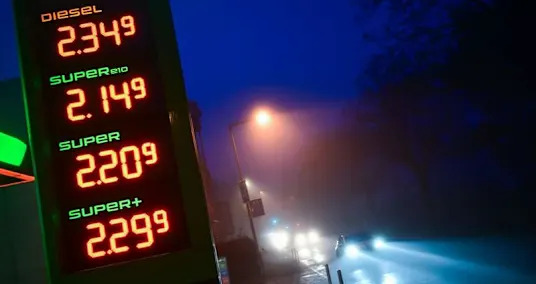

A new rule to limit fuel price hikes took effect in Germany on Wednesday, limiting petrol station to raising prices no more than once a day in a bid to bring down costs for motorists amid a surge in oil prices caused by the Iran war.
Under the new restrictions, petrol stations are only allowed to raise prices once at midday to limit price fluctuations and ensure greater transparency. Price reductions will still be allowed at any time.
Prices went up by as much as €0.2 ($0.23) per litre at noon (1000 GMT) but the hikes varied across petrol stations, as observed by dpa reporters.
A station in the northern outskirts of Berlin raised prices by between €0.06 and €0.08.
According to an analysis by motoring organization ADAC, 1 litre of Super E10 petrol was sold at an average of €2.175 across Germany shortly after noon, €0.076 more than shortly before noon.
The average price of diesel rose by €0.075 to €2.376, significantly higher than peak prices recorded on Tuesday morning.
The law was published in the Federal Law Gazette on Tuesday. In adopting the measure, the German government is following Austria, where a similar rule has been in place for some time and was recently tightened.
The ADAC and petrol station operators have expressed doubt that the new regulation will have a major effect.
Violations of the new rule can be punished with fines of up to €100,000 ($115,700). The "fuel measures package" also includes tougher antitrust rules. Germany's Federal Cartel Office will be given more powers to act against excessive prices.
Monika Schnitzer, a leading economist, warned against further intervention to bring down fuel prices, instead calling on drivers to cut down on trips.
Noting that the closure of the Strait of Hormuz has led to a shortage of oil, "people need to think about where it’s really essential to drive, where they can do without it, where they can carpool, and where they might be able to use public transport," she told public broadcaster ZDF.
Schnitzer, who is part of the German Council of Economic Experts, a five-member council also known as the "Five Sages" that advises the government on economic policy, also advocated for the current situation to be taken as an incentive to accelerate transition to renewables.
"We need to become less reliant on these fossil fuels," said Schnitzer. It was clear "that the best way out of this situation is to focus all our efforts on expanding renewable energy," she said.
LATEST POSTS
- 1
 Google's proposed data center in orbit will face issues with space debris in an already crowded orbit
 - 2Everything you should know before booking a trip to Spain
- 32025 Yachting Editors' Choice Awards: Yachts
- 4Record-breaking flu hospitalizations in New York in a single week: Health officials
- 55 State of the art Advancements in Computer generated Simulation


- Staggering Spots to Stargaze All over the Planet
- Infants will no longer receive hepatitis B vaccine at birth, CDC announces
- How did humans evolve, and will we evolve more?
- Netflix's 'Lord of the Flies' show blends 'Adolescence' and 'Yellowjackets'
- Couch Styles of 2024: What's Moving
- 'Wow!' The eye surgery marathon that restored sight for some South Africans
- ‘It’s Israeli policy’: Report reveals abuse of Palestinians in prisons
- The most effective method to Pick the Right Old Consideration Administration: Key Contemplations
- Select Your Definitive Pizza Decision